
Article6 Metrics to Measure Text Performance for P2P
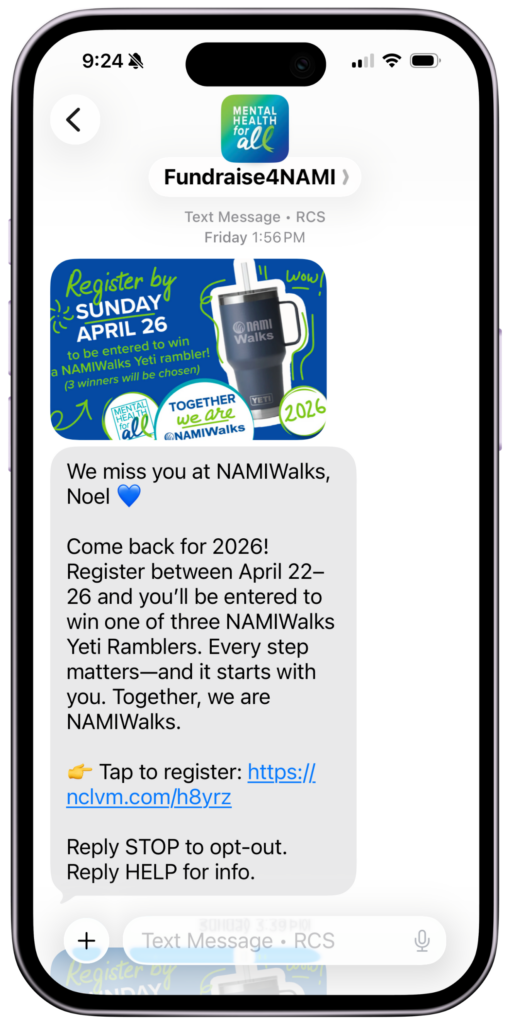 As I read the latest M+R Benchmark Study last week, it struck me that most nonprofits are using – and measuring – text messaging less effectively than they could.
The M+R data focuses heavily on direct response fundraising. Their mobile messaging metrics centered on list growth and revenue attributed to text appeals – the same metrics often used to evaluate email performance. But text messaging isn’t a replacement for email, and organizations that treat it that way risk burning through their lists quickly. Because unlike email, text is an interrupt-driven channel. And interrupted people can quickly become annoyed, disengage, and opt out.
But texting for peer-to-peer (P2P) campaigns hits differently.
When we text P2P participants, we are not simply asking for a donation. We are building relationships over time. We are inviting people back into the community, acknowledging their accomplishments, celebrating their milestones, and coaching them through their fundraising journey.
That means the most important text metrics for P2P are not transactional metrics. They are behavioral and relationship-driven metrics.
What Are the Right Text Messaging KPIs for P2P Fundraising?
If you are evaluating text messaging performance in a P2P campaign, revenue is not the metric to watch. Instead, focus on engagement metrics and participant outcomes, such as:
1. Participant Retention rate
For recruitment messages, measure how many lapsed participants return after receiving a text message. Retaining a past participant is less expensive – and more valuable – than acquiring a new one. Text messaging is one of the most effective and efficient ways to bring former team captains and fundraisers back into the program.
2. MESSAGE ENGAGEMENT METRICS
Are people are interacting with your messages? Measuring engagement metrics like RCS read counts and link clicks can tell you whether your messages are hitting the mark. Engagement signals relevance. If people interact, the content is resonating.
3. DESIRED ACTION COMPLETION RATE
Through a P2P coaching text series, we ask participants to take actions we know will lead to higher fundraising outcomes:
- Updating and sharing their fundraising page
- Using a fundraising mobile app
- Getting your first donation
- Making a self-donation
Measure how many more participants complete these key actions after receiving coaching texts and compare with those that did not.
4. FUNDRAISER PERFORMANCE LIFT
The goal of P2P coaching texts is to help participants maximize their fundraising potential. At the end of your campaign, measure how much more fundraisers raised if they received coaching text messages. Compare participants who received fundraising tips, milestone reminders, and encouragement against those who did not. This helps quantify the true revenue impact of coaching communications.
5. TEAM PERFORMANCE LIFT
Team captains often drive outsized results. Coaching them to recruit members, motivate teammates, and stay organized can create a multiplier effect across the campaign. Measure the results of teams whose captains received coaching texts versus those who did not.
6. OPT-OUT RATE
Are you maintaining a low unsubscribe rate? Opt-out rate is one of the clearest signals of message quality and cadence. If too many people leave, your content may be irrelevant, too frequent, or poorly timed. Low opt-out rates (under 2%) usually indicate that messages are timely, helpful, and valued.
Why This Matters
Too many organizations judge text messaging only by the standards of direct response fundraising: text-attributed revenue. Case and point: the 2026 M+R Benchmarks Study reported that mobile messaging drove less than 1% of total online revenue in 2025. But when the goal of your text campaign is not direct donations, that metric greatly underestimates the value that text can bring:
- A coaching text that inspires a participant to raise an additional $100
- A reminder that reactivates a lapsed fundraiser
- A message that helps a captain recruit five teammates
The dollars associated with these messages may not count as “text-attributed revenue,” but their value is real—and will likely generate greater lifetime value than a one-time donation appeal.
These outcomes matter, but only if organizations measure them correctly.
The Best P2P Text Programs Focus on the Right Message, Right Person, Right Time
The most successful nonprofit texting programs are not built around mass sends or direct donation asks. They focus on delivering the right message to the right audience at the right time.
When organizations do this well, text messaging becomes more than a communications channel. It becomes a driver of retention, fundraising growth, and participant satisfaction.
Final Thought
For most nonprofit organizations, the purpose of text messaging should not be limited to one-time responses. Its greatest value often comes from sustained engagement that leads to stronger retention, higher fundraising performance, and long-term loyalty.
Direct response texting can drive transactions.
But for P2P fundraising, texting drives engagement, behavior change, and stronger communities.
Want to learn more about Nuclavis Mobile Messaging? Schedule time with us.