
Case Study, White PaperCanadian Cancer Society Relay For Life: Drives More Fundraising Through Mobile Engagement
Download the case study, for free!
Download Now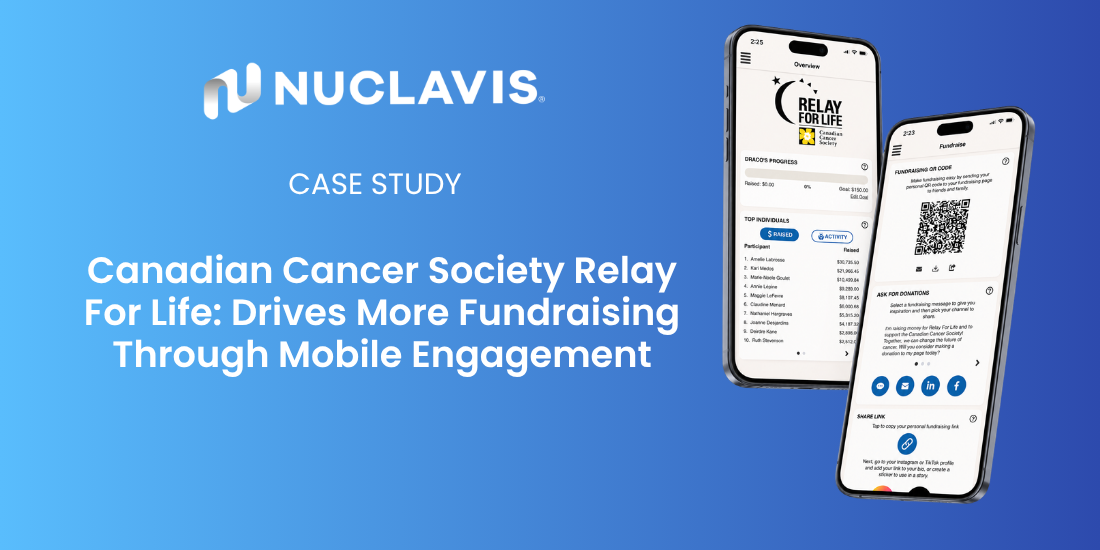
Overview
The Canadian Cancer Society’s Relay For Life Youth and Relay For Life Community programs give participants a powerful way to rally their schools, families, friends, and local communities around cancer research and support. In 2026, Canadian Cancer Society added a new mobile fundraising experience powered by Nuclavis, giving participants faster ways to share personal pages, activate QR codes, and turn in-person momentum into immediate online gifts.
In its first year, the mobile app became a meaningful fundraising channel: $1.88 million in app – attributed fundraising, representing 14%+ of combined online fundraising across Youth and Community through June 30, 2026. Youth led the results, generating $1.48 million through the app and proving that mobile-first tools are especially important for meeting younger fundraisers where they already engage.
The Challenge
- Connect with Youth and Community participants wherever fundraising happens.
- One-step approach for making a fundraising ask with suggested templates
- Reduce friction with one-tap tiny URL’s and scanning QR Codes making giving easier than ever
- Create measurable revenue impact, not just another engagement channel.
The Solution
- A Nuclavis-powered branded mobile app with fast access to fundraising tools.
- Smart QR codes for every fundraiser making it easy to make the ask
- Multiple channel options including social, SMS, and email.
- Mobile-first sharing that lets participants optimize the fundraising ask.
Real-World Impact
Relay For Life fundraisers embraced the same behavior that has made mobile giving effective across peer-to-peer programs: scan, share, and donate from the device already in hand. QR codes became the strongest app-attributed fundraising channel across both Relay For Life programs, while social-share links provided the next-largest source of app-attributed revenue.
- $1.88M app-attributed fundraising
- 14% combined online revenue share
- 7,883 mobile app users
- $1.14M raised through QR codes
Results
| Metric | Relay For Life Youth | Relay For Life Community |
|---|---|---|
| Mobile App Users | 6,992 | 891 |
| Mobile App Revenue | $1,483,400 | $399,788 |
| % Mobile App Revenue of Online | 14.74% | 12.08% |
| Average Raised: app user | $324 | $1,040 |
| Average Raised: non-app user | $206 | $476 |
| Fundraising lift for Mobile App Users | 57% higher | 119% higher |
What Drove the Impact
- QR codes removed donation friction. Youth participants generated $918,290 through QR codes, and Community participants generated $219,375 - a combined $1,137,665 in app-attributed fundraising.
- Mobile sharing matched participant behavior. Participants could share through social links, SMS, and email making fundraising easier in the channels they already use.
- Youth performance validated the mobile opportunity. Youth generated nearly four times the app-attributed revenue of Community and 14.74% of online fundraising from the app, reinforcing the value of engaging younger fundraisers through mobile-first tools.
- App users raised more. App users outperformed non-app users by 57% in Youth and 119% in Community, showing that mobile tools were associated with stronger participant fundraising performance.
Channel Highlights
Youth
- $918,290 raised through QR codes
- $1,483,400 total app-attributed fundraising
- 29,279 recorded donations
Community
- $219,375 raised through QR code
- $399,788 total app-attributed fundraising
- 5,475 recorded donations
Why It Worked
The Nuclavis mobile app worked because it aligned fundraising tools with real-world Relay behavior. Participants did not need to wait until they were at a desktop or ask supporters to search for a link later. A QR code or mobile share could turn a conversation at a school, workplace, community event, or gathering into an immediate donation opportunity.
The strongest opportunity ahead is adoption growth. With 7,883 participants using the mobile app in year one, even incremental adoption gains could expand the revenue base tied to higher-performing mobile fundraisers.
Conclusion
In the first year of the Relay For Life mobile app, Canadian Cancer Society demonstrated that mobile-first tools can materially increase peer-to-peer fundraising. Across Youth and Community, the app drove $1.88 million in app- attributed revenue, with QR codes contributing more than $1.13 million and app users raising meaningfully more than non-app users.
For organizations looking to modernize community-based fundraising, CCS Relay For Life shows the value of removing friction, enabling mobile sharing, and meeting fundraisers where they already engage.