
ArticleDon’t Let FOMO Drive Your AI Strategy
We’ve all seen the headlines about how AI is going to change the world. Or, according to some people, already has changed the world. Most of us have also probably been told by our leadership that we must start using AI. It’s all a bit unnerving, and it’s easy to feel like Alice falling through the looking glass, not knowing what to do exactly.
 I’ve worked in the technology sector for thirty years and have seen many new “The World Will Never Be the Same” tools come on the scene. Commerce moving online, SaaS solutions, mobile, and now AI. Each of these solutions was, in its own way, a true disruptor. All of them also had their own challenges with knowing exactly what they were and how to implement them. But out of all of them, I think AI presents the biggest challenges when it comes to settling on an informed approach that is right for you and your organization. I believe it’s harder because of a few critical challenges. Let’s take a look at each of these in a bit more detail.
So..Many..Options
Imagine you go to the hardware store to buy a wrench. Seems simple enough. But then you find the wrench aisle and are confronted with so many different wrenches. Seriously, who knew there were so many types of wrenches? I did a cursory search in Amazon for wrenches and got 13 different options just for head type! It’s the same challenge with AI tool adoption.
For our purposes, let’s narrow our AI focus to only Large Language Models (LLMs). Great, that should make it easy, right? Well, not really. Even limiting to just LLM’s there are at least 10 solutions publicly available in the US, including Claude, ChatGPT, Meta AI, Copilot, and Gemini. So, let’s say you settle on your LLM of choice; now you need to choose how you’re going to use it. Will you only access it via the browser, basically on-demand usage? Or will you set up the app on your computer and run something like Claude Desktop? If you set up a desktop app, will you activate agents to run on your desktop? It’s a lot of choices you must make.
The Jargon Hurdle
Navigating all these choices is made even harder because it seems people talk about AI in some sort of alternate language. As you research, you’ll come upon new words or acronyms that you might not have any idea what they mean. RAG. Prompt. Desktop. DAG. MCP’s. Agents. Abstraction. Diagnostic Linting. I understand what most of those terms mean, although there is one that I have zero idea about, but I’ll leave it to your imagination to figure out which one. Here’s the key: I only know because I’ve put in quite a bit of time learning them. That’s the challenge: there’s a rather steep learning curve with understanding what exactly AI is and does, and to climb that curve you have to first understand the language of AI. But if you don’t put that time in, you won’t be making an informed decision.
My advice is: before you rush to a decision, do some learning and research to understand AI and the options available. So, how do you do that? Well, I’ll tell you how I’ve gone about learning. When it comes to the game of AI Jargon Bingo, I have used AI to explain it to me. I know that seems counterintuitive, but I think my process works. I’ll use two different LLM models and ask them both the same question, such as “explain RAG to me assuming I am just learning about AI and am not an expert”. I then compare the answers, look for inconsistencies, and research them through web searches. I’ll also use the information provided to do more research on the web myself to expand and check what the models told me. It sounds weird, but I’ve found that AI is actually really good at explaining itself.
I’ve also found good sources to follow on social media, such as Dr. Casey Fiesler, who I really like because she’s easy to understand and, very importantly to me, she brings ethics into the conversation. The trick is to find the process that works best for you, but you must find a process and DO YOUR RESEARCH!
Access vs. Security
When I was consulting, my customers would frequently ask me some variation of “Can we do this?” My response was always the same. I pointed out that with enough time and money, we can do anything. The right question isn’t “can we do this?” but rather “should we do this?” Just because we can do something doesn’t mean we should. I’ve used this basic tenet for over twenty years when navigating software needs; it’s never failed me. In the world of AI, I think the question of Should versus Can isn’t just important; it’s critical. The challenge, however, is that it’s also much more complicated.
Software’s access to critical data has long been a point of contention, requiring a balance between performance and security. I would wager every software developer has had to design around something because they couldn’t access the data they wanted due to security concerns. AI takes data-security contention up to 11. Why? Because AI models need data to learn. Data to AI models is like oxygen to humans. On average, the more data a model has access to, the better it performs. But the more data you give a 3rd party model access to, the more you’re putting your sensitive data at risk. So, while balancing technology and security is nothing new, it seems much harder with AI because it’s harder to engineer your way around protected data.
How do we navigate this new and very real security question?
My approach is first establishing a clear line of demarcation for data that will not be made available to AI models. For example, Personally Identifiable Information (PII) of your donors, or our trade secrets. Once you establish this demarcation, you enter the realm of how uncomfortable you’re willing to get. Work with your Information Security teams and Executive Leadership to agree on what level of discomfort works for you and your organization. Every organization has different tolerances, but it’s imperative to have this conversation. I would also urge you to remember that AI models are really good at getting the data they want. We’ve all seen the news stories about “rogue AI agents”. While these stories, in my opinion, try to anthropomorphize the AI agent to deflect blame from the companies and people in charge of the AI, the risk to our data is still there, and we should take it seriously.
Finally, after implementing your policy, you must police it. IT tools can help with this, so find one that works for you and your organization and get it up and running. One last comment about AI security… It’s never evolving. Just as AI is ever-evolving, your policies and procedures must constantly adapt to meet the new realities AI models bring. Stay up to date on the latest by using trusted news sources to keep tabs on the industry and adjust your policies accordingly.
FOMO
The software industry is strange; it’s almost like a junior high school cafeteria, except in this case the cool table is whatever the latest trendy software is that everyone MUST use. As long as I’ve been in tech, it’s always been that way. I still remember all the companies that felt impelled to place “.com” at the end of their name during the original internet boom. The same thing is happening again with AI, but it feels like it’s amped up even higher.
We’ve all either been in a meeting or heard about a meeting where somebody in senior leadership is explaining how “we need to use AI.” Makes sense; it’s a potentially transformational tool, so leaning into using it sounds very logical. The problem, however, arises when you realize there often aren’t a lot of details beyond the announcement to use more AI. This isn’t always the case, but it happens frequently enough that we’ve all at least heard about it. It often feels as if leadership is rushing to catch a train without knowing where it’s going, or sometimes even that it is a train.
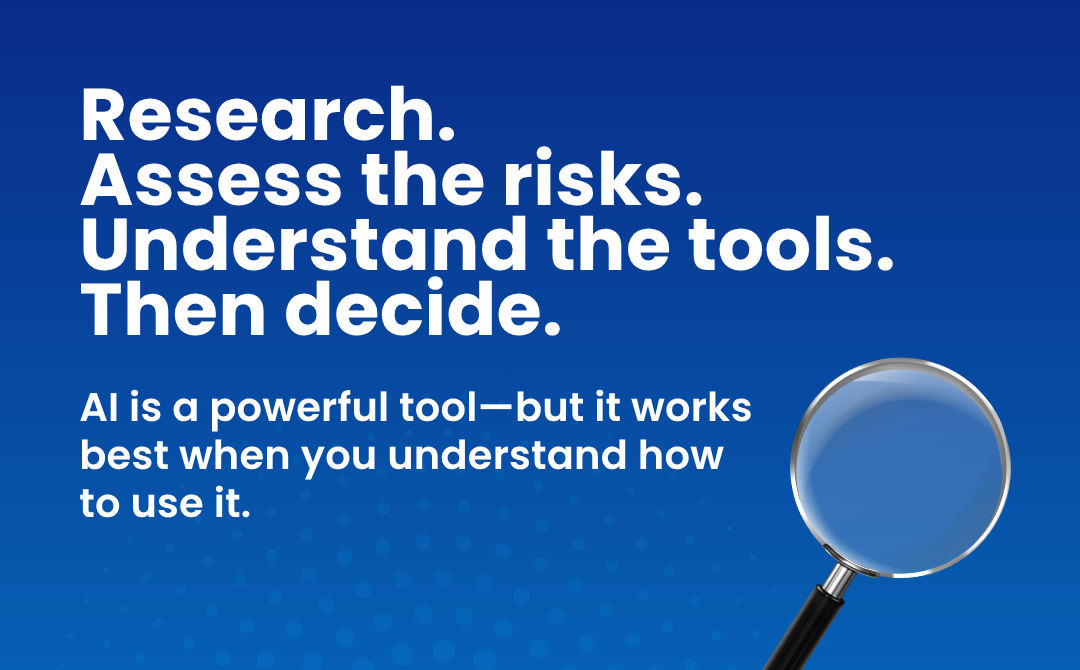 Given the pressures of the market, it’s understandable that we all have a fear that we’re missing the AI train. However, before we ask our staff to jump, we owe it to them to spend time researching AI and how it makes the most sense for our organizations.
Conclusion
I’ll leave you with a quick synopsis on implementing AI at work:
- Do your research
- Find the level of risk that works for you and your organization
- Look and understand before you leap
AI is truly an amazing tool; however, remember two things. First, despite what some want you to believe, it’s not magic, so don’t treat it like it is. At the end of the day, AI is a tool that is incredibly powerful at some tasks but not so great at others. In other words, it’s just like any other tool. And remember, the best way to use a tool is to understand how it works first.